Open Gaps in the S&P 500: Why Most Get Filled
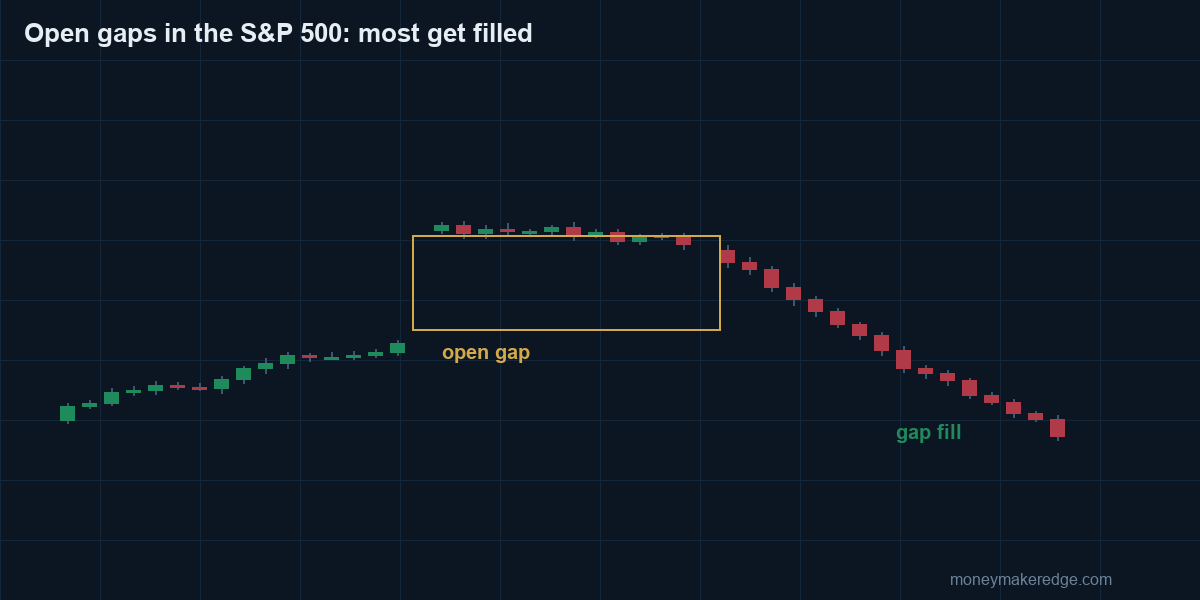
A gap is an empty zone on the chart where no trading happened: the market opened above yesterday’s high or below yesterday’s low and never traded in between. Gaps show urgency. In the S&P 500, where the emini trades almost around the clock, most cash-session gaps get filled – price comes back to trade through the empty zone – and the gap fill is one of the most consistent day-trading setups there is.
Three kinds of gaps
- Common gaps inside a range: small, frequent, and filled quickly. These are the bread-and-butter gap-fill trades.
- Breakaway gaps that start a new trend out of a consolidation: these often do not fill for a long time, and fading them is expensive.
- Exhaustion gaps at the end of a trend: a last rush of buyers, frequently followed by an island reversal. These fill, and fast.
Why buyer exhaustion leaves open gaps
A gap up after a long rally is usually the last of the buyers arriving – the news is out, the crowd is in, and there is nobody left to push. When the gap stays open for several sessions with price unable to extend, it is a sign of exhaustion. The first strong down session then tends to fill the gap in one move, because there is no support inside an empty zone.
Trading the gap fill
We do not fade every gap at the open – that is how traders get run over on breakaway days. We wait for the first 15-30 minutes to show whether buyers are extending or failing. A failure to make a new high, followed by a break of the opening range low, is the entry; the stop goes above the opening range high; the target is the gap fill – yesterday’s close. The risk is small and defined, the target is known before the entry, and the setup repeats week after week.
The levels around a gap
Gap edges behave like support and resistance. Once a gap fills, the far edge often turns the market back the other way, which makes the fill itself a level to trade from.
New to Money Maker Edge? Start here.
Everything on this blog comes from one method: defined risk, a written plan, and live trading with a group. Learn it in three days, then trade it every market day.
The 3-day day trading course · The live trading room · Day trading psychology · Call 866-640-3737