
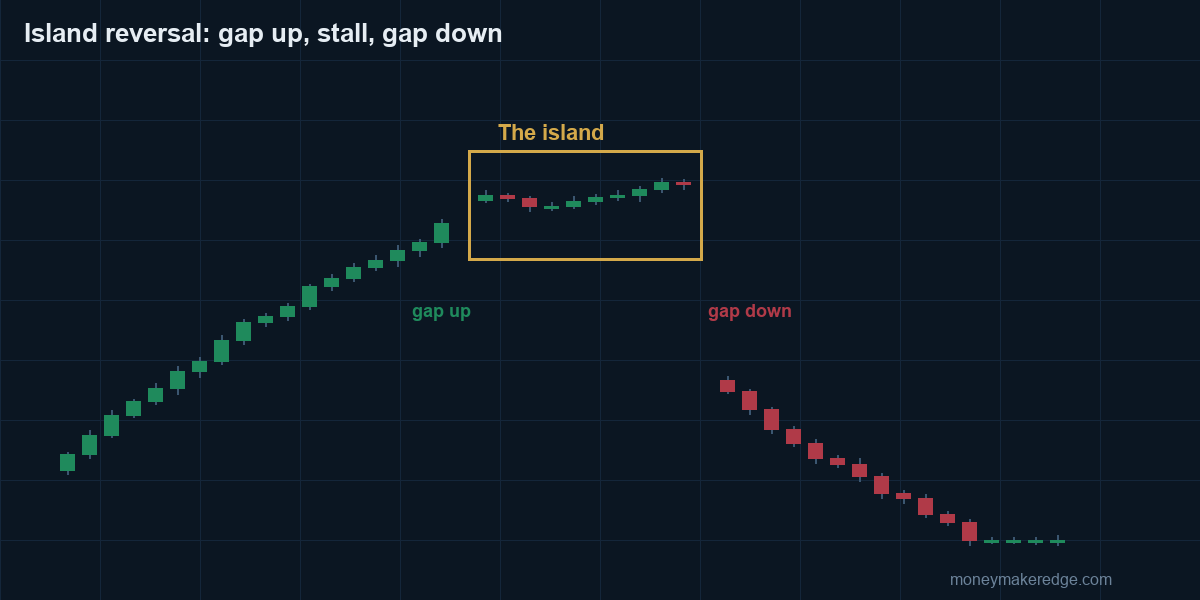
An island reversal is one of the most reliable reversal patterns because of what it does to the people who traded it. After a trend, price gaps in the direction of the trend, trades sideways for one or more sessions, then gaps back the other way. The candles in the middle are left stranded – an island – with every trader who bought them now under water and looking to get out.
How to recognize it
- A clear trend into the pattern. Without a trend there is nothing to reverse.
- An exhaustion gap in the trend direction, usually on news or a late rush of buyers.
- A cluster of sideways candles – the island – on rising but unconvincing volume.
- A breakaway gap in the opposite direction that leaves a clean empty zone between the island and the rest of the chart.
Why it works
Gaps show urgency. The first gap is the last of the buyers rushing in; the second gap is those same buyers rushing out. Because the island sits above (or below) every other price on the chart, there is no support to slow the move once it starts – which is why island reversals tend to travel quickly and far.
Trading the island reversal
The entry is the breakaway gap: we sell the first pullback toward the gap after a bearish island, with the stop above the island’s high. If price trades back into the island, the pattern has failed and we are out – that is the whole risk, defined before the entry. The first target is the level where the trend started, and old support below the island becomes the place to take profits.
Keep it in context
On the S&P 500 emini, gaps fill more often than they do in individual stocks, so we wait for the second gap to hold for at least the first hour before committing. See our note on open gaps in the S&P 500, and the double top, another reversal pattern built on trapped buyers.
Want to trade this with defined risk and a written plan? That is exactly what the 3-day day trading course teaches, and what we do every market day in the live trading room. Call 866-640-3737.