Double Top Pattern: How to Spot and Trade It
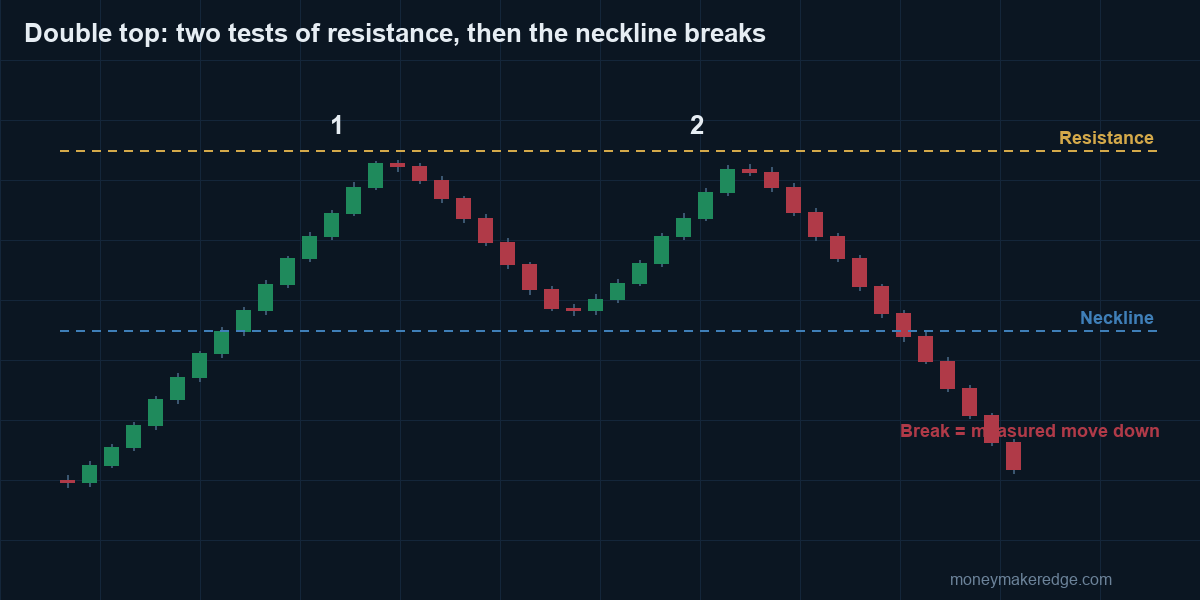
A double top forms when price rallies to a resistance level, pulls back, rallies to the same level again, and fails. The two peaks show that buyers could not get through at the same price twice; the trade is confirmed when the low between the peaks – the neckline – breaks. It is one of the oldest reversal patterns and still one of the cleanest, because it is built on a simple fact: trapped buyers.
Anatomy of the pattern
- Peak 1: a rally into resistance, often on good news and high volume.
- The pullback: sets the neckline. The deeper the pullback, the bigger the eventual measured move.
- Peak 2: a second test of resistance, usually on lower volume. The failure here is the first real signal.
- The neckline break: confirmation. Every buyer from both peaks is now under water.
The mistake most traders make
Shorting the second peak because it ‘looks like’ a double top. Until the neckline breaks, the pattern is just a range, and ranges break upward as often as downward. We wait for the break, or for a clear rejection at peak 2 with the stop above the highs – never a guess in the middle.
How we trade it
The cleanest entry is a retest of the broken neckline from below: price breaks, bounces back to the line, fails, and we sell with the stop above the retest high. The target is the measured move – the height from the peaks to the neckline, projected down from the break. On the S&P 500 that often coincides with a prior support level, which is where we take profit.
Double tops and moving averages
When a double top completes near a falling 50-day moving average crossing below the 200-day (the so-called death cross), the pattern has the trend behind it and the moves tend to extend. When it forms in a strong uptrend far above the averages, expect the first break to be bought – trade it smaller or not at all.
See also: the island reversal and broadening top, two more reversal patterns built on trapped traders.
New to Money Maker Edge? Start here.
Everything on this blog comes from one method: defined risk, a written plan, and live trading with a group. Learn it in three days, then trade it every market day.
The 3-day day trading course · The live trading room · Day trading psychology · Call 866-640-3737