
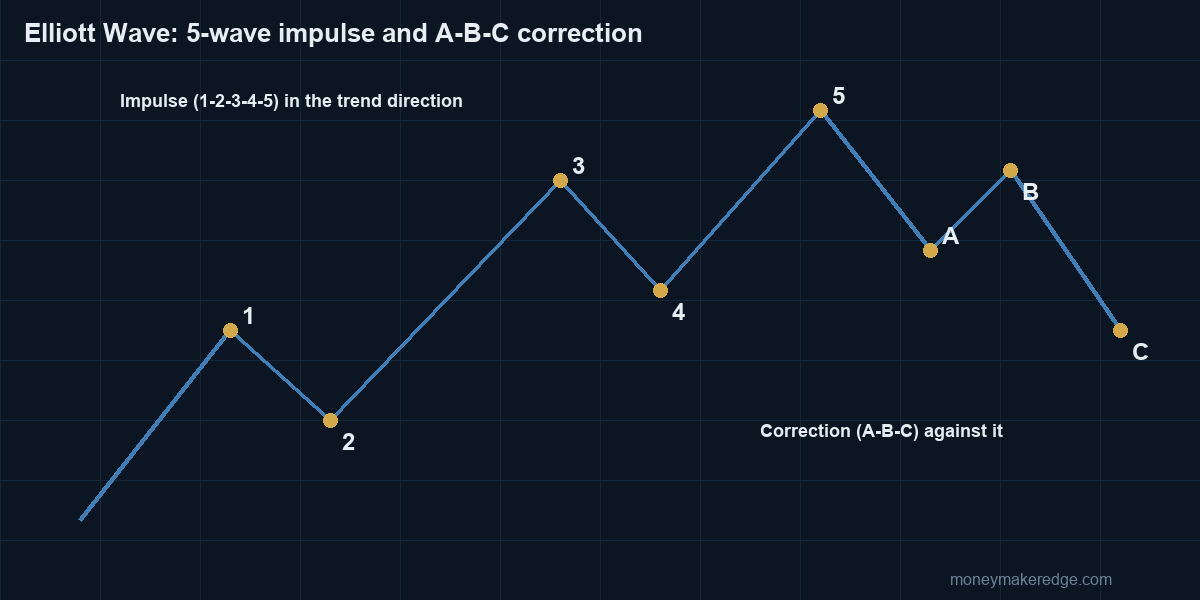
Ralph Elliott noticed in the 1930s that markets move in recognizable waves: five with the trend, three against it. You do not need to become a wave-counting purist to use the idea. For day traders the Elliott Wave principle is valuable for one thing – it tells you where you are in a move, so you know whether to expect continuation or a correction.
The 5-3 structure
- Waves 1, 3 and 5 move with the trend. Wave 3 is never the shortest and is usually the strongest – the move where everyone finally agrees on direction.
- Waves 2 and 4 are pullbacks. Wave 2 often retraces deep (50-61.8%); wave 4 is usually shallower and more sideways.
- Waves A, B and C correct the whole impulse. B is the trap – a rally that looks like the trend resuming, then C takes it away.
The only rules that matter intraday
- Wave 2 cannot retrace more than 100% of wave 1 – if it does, the count is wrong and so is the trend you think you are in.
- Wave 3 is never the shortest impulse wave.
- Wave 4 should not overlap the top of wave 1 in a clean impulse.
How we actually use it
We are not trying to label every wiggle on a one-minute chart. We use the principle as a map: after a strong wave 3, we expect a wave 4 pullback and look for the wave 5 entry at a Fibonacci level with a defined stop. After a five-wave move completes, we expect an A-B-C correction and stop chasing. The count tells us when to be aggressive and when to be patient – the two states that separate profitable traders from busy ones.
Where it fails
Wave counts are easy to fit after the fact and hard to trust in real time. That is why the count is never the reason for a trade. The reason is always the same: a level, a reaction, a defined risk. The wave structure just tells us which way to lean.
See also: Fibonacci retracements and broadening tops.
Want to trade this with defined risk and a written plan? That is exactly what the 3-day day trading course teaches, and what we do every market day in the live trading room. Call 866-640-3737.